Showing posts with label Brussels. Show all posts

Event Report: “Humans in the Arctic”


courtesy of Torjus Kandal
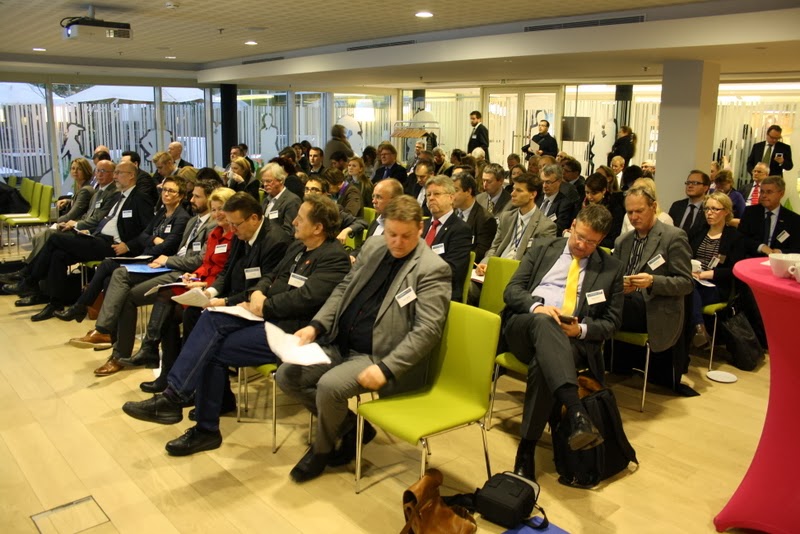
By Andreas Raspotnik and Kathrin Keil On November 26, 2013 the North Norway European Office held a seminar on “Humans in the Arctic”, in collaboration with Arctic Frontiers 2014, The Arctic Institute and Maritimt Forum Nord. The seminar took place in conjunction with the annual conference Arctic Frontiers, to be held in Tromsø (Norway) from January 19th to 24th, 2014.

In two sessions, one on Growth and one on Governance and Cooperation “Humans in the Arctic” addressed the emerging environmental and social challenges as well as economic opportunities that arise from the continuous development of the European and in particular Norwegian Arctic. With the European Union and its institutions, and other European stakeholders from industry and research showing increasing interest towards these developments, the Norwegian North is a key area in bringing together old and new actors, and thereby fostering a sustainable future for the European Arctic.

More than 100 participants from politics, industry, research and academia paid careful attention to the introduction by Runar Sjåstad, County Mayor of Finnmark County and the two Members of the European Parliament, Jens Nilsson and Paul Rübig.


Anne Husebekk, rector from the University of Tromsø (UiT), introduced the 1st session and gave an overview on the increased global attention on Arctic development and its expected economic growth. The Tromsø High North Cluster can play a crucial role in providing the necessary knowledge for sustainable development in the Norwegian Arctic. In that regard Dan Tuppen, Vice President for Exploration, Barents Sea and Norwegian Sea from the energy company Statoil highlighted the potentials of the Barents Sea as a future source for European energy supply. However, Tuppen outlined the risks and long-term considerations attached to Arctic maritime drilling. With Arctic shipping often being perceived as the top-seller of Arctic economic development, Hanna Lee-Behrens, Director of the Department of Safety, Environment and Innovation from the Norwegian Shipowners’ Association, discussed related maritime opportunities and challenges in the High North. 

courtesy of Torjus Kandal
In that regard she presented the report “High North – High Stakes. Maritime opportunities in the Arctic”, which draws on conclusions and data from a related report published by The Arctic Institute. As especially intra-Arctic shipping is expected to grow, Lee-Behrens emphasized the necessity of a mandatory Polar Code, currently developed by the International Maritime Organization (IMO) and its member states. In addition to maritime transport deliberations fishery plays a crucial role for economic considerations in the Barents Sea region. Trygve Myrvang, Managing Director from the Norwegian Fishermen’s Sales Organization, outlined questions on the sustainability of fish stocks in the Norwegian North. 

In order to sustain the current success story Myrvang underlined the necessity of cooperation between the fishery and energy industry in the High North, both interested in the same offshore areas. Filip Hamro-Drotz from the European Economic and Social Committee (EESC) concluded the first session and critically assessed the interaction between civil society and businesses in the European Arctic. He urged the representatives from the European Arctic to particularly focus on their competitive advantage in the area and continuously stress their needed knowledge and skills.

The speakers in the 2nd session focused on on-going challenges concerning governance and cooperation especially with regard to the Arctic Council and the European Union’s related Arctic policy steps. Anne Kari Ovind, Deputy Director General of the Norwegian Ministry of Foreign Affairs, highlighted the official Norwegian perspectives of and approaches to fruitful cooperation in the Arctic. Nicola Payne, Second Secretary, Mission of Canada to the European Union, continued by outlining the Canadian goals set for its two-year Arctic Council chairmanship. 

Additionally Mrs Payneemphasized several key elements of the recently agreed on EU-Canadian trade agreement as a platform to also bilaterally cooperate on circumpolar issues. Ole Kristian Bjerkemo, Chair of the Arctic Council’s Working Group on Emergency Prevention, Preparedness and Response (EPPR) gave an overview of the maritime cooperation efforts negotiated under the auspice of the Arctic Council, the Arctic Search and Rescue Agreement and the Agreement on Cooperation on Marine Oil Pollution Preparedness and Response in the Arctic. Matthew King, Head of Unit: Maritime policy, Atlantic, outermost regions and Arctic in the European Commission’s Directorate-General for Maritime Affairs and Fisheries, concluded the session. King advanced his opinion that the European Union has to (finally) activate its Arctic policy and related funds more effectively. Furthermore, the European Union should also seek to develop its Arctic policy ambitions outside the Arctic Council.

Final remarks were given by Ole Øvretveit, Conference Manager of Arctic Frontiers and Tomas Norvall, Chair of Nordland County Council and Board Member of the Norway European Office.

Arctic Frontiers 2014 under the theme “Humans in the Arctic” will focus on two main subject areas: 1) health, society and environment and 2) maritime operational challenges. The provisional policy section program can be downloaded here, the one for the science section here. The Arctic Institute, which will be represented by its members Malte Humpert, Kathrin Keil and Andreas Raspotnik, will host a side event on infrastructure related challenges in the Arctic.


EU Arctic Policy: Caught between Energy Security and Climate Change


by Kathrin Keil A number of opportunities for the European Union to get involved in Arctic affairs exist, one of them being a strengthened energy-partnership with Norway. The EU has indeed put a focus on the Arctic’s energy potential. As the 2008 Communication from the Commission to the European Parliament and the Council reads: “Arctic resources could contribute to enhancing the EU’s security of supply concerning energy and raw materials in general.” However, when reading the official EU documents on the Arctic (there have not been many: the previously mentioned Commission Communication in 2008, a Parliament resolution in 2009, a Report in 2010, and Council Conclusions on Arctic issues in 2009), it becomes clear that the EU has overall remained pretty general and vague about its envisioned EU Arctic Policy.

In particular the general nature of these documents depicts a harmony that is not realistic. The papers fail to expand upon potentially contradicting policy issues that the EU faces in its current, premature Arctic policy approach. The most apparent contradiction comes to light when considering the two policy-areas the EU emphasizes the most when presenting its interests and ambitions in the region: energy security – mainly understood in terms of security of supply – and climate change.

First, it is important to note that these issue areas are highly interconnected. The reliance on fossil fuels for energy generation contributes to the changing climate and is responsible for most of today's and future GHG emissions. The effects of climate chance will be felt first and foremost in the Arctic region where temperatures are slated to increase at twice the rate of lower latitudes. The EU's decision  to reduce greenhouse gas emissions by 20%, increase the share of renewable energy to 20%, and improve energy efficiency by 20% , represents the first steps to limiting future GHG emissions [1].

The EU’s goals in the Arctic when compared to the EU's climate change agenda clearly illustrates the Union's contradictory policy approaches. Energy security for the EU must be understood in terms of security of supply. In order to address growing energy scarcity and dependence the EU aims to find new and diversified energy sources. The Arctic holds significant amounts of conventional energy resources – mainly oil and natural gas. The  increasing reliance on hydrocarbon resources in the Arctic contradicts the goals of the EU’s climate change policy to achieve reduction of GHG emissions and rapid growth of the renewable energy sector. These divergent approaches may lead to questions about the region's leadership role in the fight against climate change. The Swedish government in its evaluation of the Commission’s Communication points out this contradiction.

The EU's continued financial support of Carbon Capture and Storage (CCS) may also weaken the EU's support of and focus on spurring investments in renewable energies and promotion research on alternative low-emission energy production.

Additionally, the exploitation of Arctic resources is very energy intensive – running counter to the EU’s goals to improve energy efficiency – and could potentially damage the local environment and contribute to GHG emissions.

The EU's goal to profit from newly discovered energy resources in the High North, which are predominantly expected in the Russian part of the Arctic, runs counter the current ambition of many EU member states seeking to reduce their energy dependence on Russia. An increased energy partnership with Norway and its Arctic hydrocarbon resources could help the EU to diversify its supply away from Russia. However, the EU cannot ignore Russia as the most important Arctic hydrocarbon actor, given that the Russian shelf holds more than half the expected oil and gas reserves in the Arctic.

The EU can certainly become a important actor and partner in Arctic issues, but the Union must more clearly define its preferences and values when entering a new regional policy field. In short, policy-makers in Brussels have to ensure that the prospective EU Arctic Policy does not contain contradictory policy preferences, with regard to climate change and energy security, but rather follows a coherent set of goals and values directed at the Arctic’s possibilities and challenges.

sources:
[1] Communication from the Commission to the European Council and the European Parliament - an energy policy for Europe {SEC(2007) 12}, http://eur-lex.europa.eu/LexUriServ/LexUriServ.do?uri=COM:2007:0001:FIN:EN:PDF).


When the Periphery Becomes the Centre - North Norway and the EU


by Andreas Østhagen Interest in the Arctic has grown considerably during the recent years. The Arctic is, at least in Norway, synonymous with North Norway. Northern Norway's relevance as a region has  subsequently grown and has found itself at the center of the widening Arctic debate. Hence, North Norway represents an intersection of international and regional politics. It is important to recognize that this interaction does not only apply nationally, but also on the international scene which is increasingly looking northwards.

Russia has long defined the Arctic as vital, both from the standpoint of economic growth  and the ability to exert political power. Canada's Prime Minister, Stephen Harper, is actively using the Arctic to promote Canadian sense of identity and sovereignty. In the United States politicians and businesses alike are beginning to realize the potential of the northern parts of Alaska, while a fierce debate about the need for an Arctic policy is taking place in the capital. In addition, China has shown a growing economic interest in Iceland, while sending  icebreakers and research ships in the High North.

These and similar issue can easily be interpreted as international high-level politics, which do not relate to local affairs or business in North Norway. A more nuanced interpretation, however, will allow to draw direct connections to regional politics and interests. It is by no means a coincidence that the Norwegian foreign minister, Jonas Gahr Støre, visits North Norway more frequently than any other region in Norway. His Government has increased funding for the three northernmost counties, and one expects continued investment in the next strategic report for the High North. Roads are being built, research institutions created, and money transferred. Is this generosity from Oslo? Hardly.

Norway is dependent on having an active and well-developed northern Norway to legitimize its branding as an Arctic nation. Numerous stakeholders have clear, and sometimes, cynical interests in the region, and invest accordingly. The challenge, for North Norway, is to achieve greater levels of participation in the overarching debate from the local and regional level. Precisely herein lies the unique intersection between regional and the international politics, as a region that has often been at the periphery, finds itself in the center.


Thus, places other than Oslo have become relevant for North-Norwegian regional development. The EU, as a meeting place, is increasingly becoming important. In Brussels, both political and business interests are represented by numerous offices coming from all over Europe. As a meeting place for different interests, which directly and indirectly affect the development in North Norway, it is important to participate in this arena. The EU does in fact influence much of what goes on in the North, for better or for worse. And in Brussels people love dialogue, exchange of information and cooperation across borders.

Differentiated payroll tax, the export market for fish, or the demand that drives the development of new oil and gas fields, are just some examples of EU influence. The question, a northerner placed in Brussels asks himself, is thus how to make the most of the venues that are created and the opportunities that present themselves. This applies not only when the EU develops its Arctic policy, but also when a German industrial company looks for investment opportunities in the northern Norwegian ports, or a British research institute wants North Norwegian partners.

It is therefore especially important to highlight the skills and the competence that exist from the coast of Helgeland up to Kirkenes. Everything from regional county Presidents to North Norwegian students are regularly traveling to Brussels. The purpose is twofold; namely to learn how the EU affects North Norway, while at the same time promote North Norwegian interests in a European and international environment that is increasingly showing interest in the region. This interaction is likely to become more  relevant in the future, as the sea ice is melting and petroleum and shipping activity in the Arctic increases. Related, the role of the EU as a facilitator for dialogue and information between Arctic actors will continue to be of importance.

See you in Brussels.